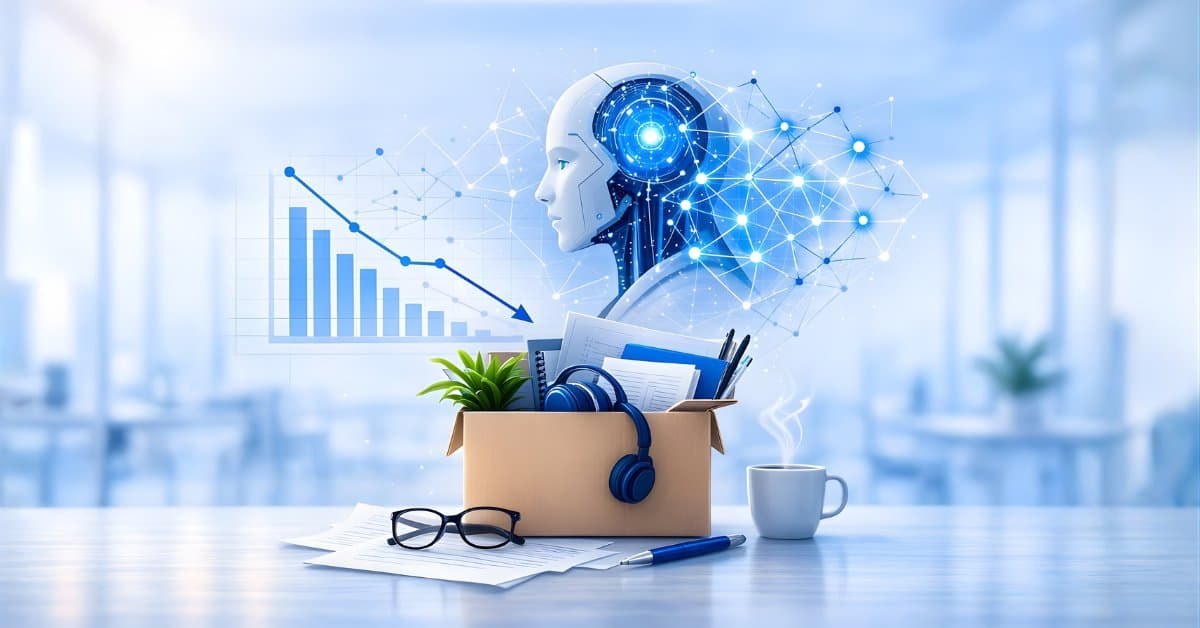
AI-driven layoffs dominate the news, with big cuts at Amazon, Goldman Sachs and Meta. The simple story is that machines are taking jobs, but the data shows AI expanding what people can do faster than it is replacing jobs.
Gartner reviewed 231 large companies representing more than 240,000 roles. It found that less than 1 percent of layoffs were directly caused by productivity gains from AI. Most cuts were tied to cost reduction or strategic repositioning. Gartner’s Emily Rose McRae says companies often mention AI during restructuring because it sounds innovative to investors. In practice, most companies use AI to support work.
The job market is cooling, but mainly for economic reasons. In its October 2025 statement, the US Federal Reserve noted slower job growth and rising risks to employment.
AI use, meanwhile, keeps expanding. According to Stanford’s AI Index, 78 percent of firms used AI in 2024, up from 55 percent in 2023. US private AI investment hit a record $109 billion the same year. Since AI already affects work, the open question is how to use it.
Professionals who apply AI to daily tasks build an edge that compounds. In interviews with Bloomberg Wealth, companies said they now favor candidates who use AI in practical ways, such as summarizing meetings, organizing information or automating simple tasks. Those skills are becoming a new kind of digital fluency, built on combining human judgment with machine output.
There is still room to stand out. McKinsey’s State of AI 2025 report finds that few companies have fully built AI into their operations. Most are still running pilots. Productivity gains are coming from smarter task design, oversight and integration. That is the opening for professionals who understand business processes and can turn technical tools into measurable results.
The people who take that opening do three things. First, they break their role into smaller tasks to see which ones AI can help with and which still need human oversight. Next, they prove the gains with data on time saved, accuracy and outcomes. Then they become the integrator, the person who makes sure AI tools deliver real business results.