More than a year of AI headlines has said less than one chart in Anthropic’s labour market report. For each type of job, it compares the tasks AI could speed up with the tasks people use it for. The authors find that real use “remains a fraction of what’s feasible.”
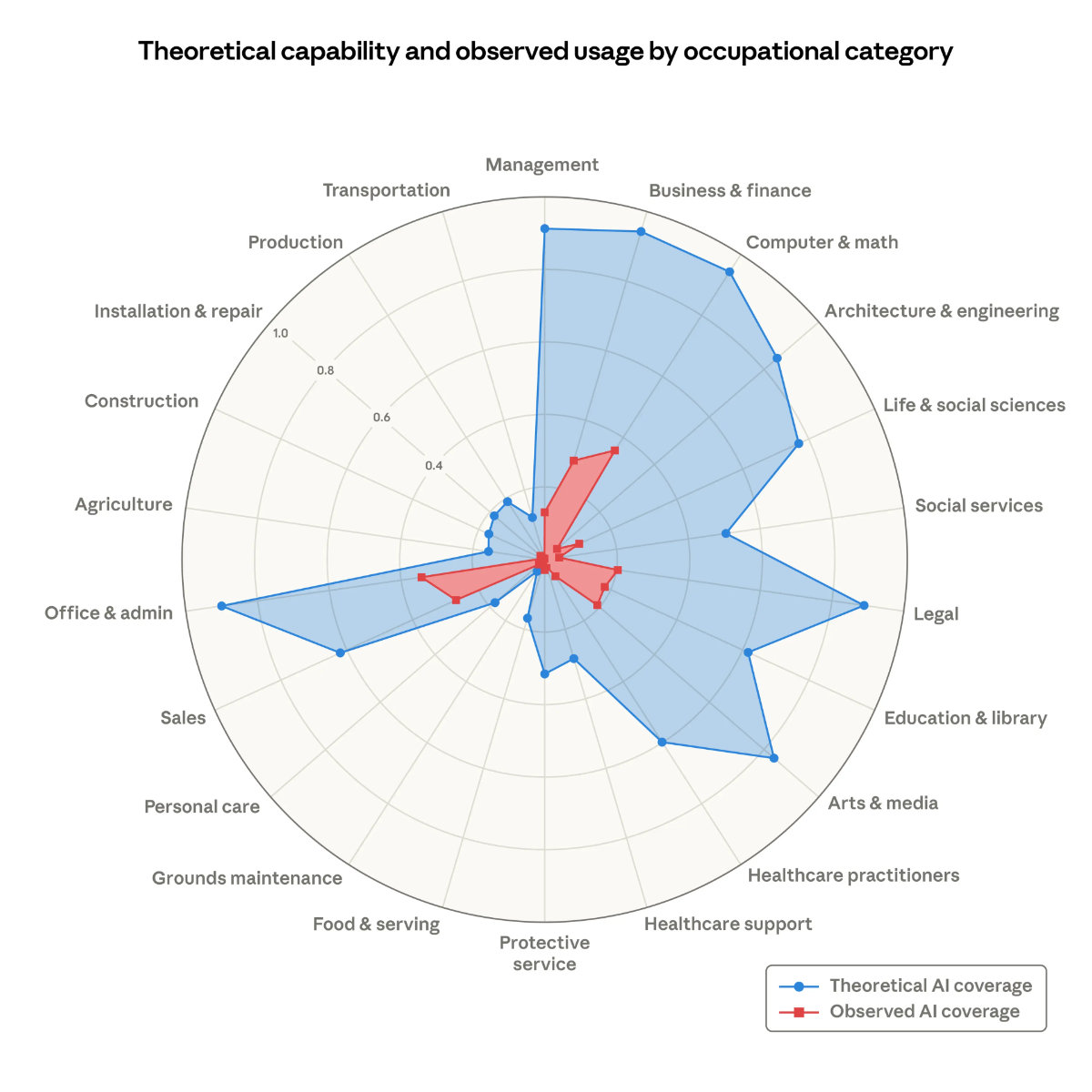
The first number comes from a 2023 paper that asked whether an AI model could in principle do the work at least twice as fast. The second is the share of those tasks where people use Claude, Anthropic’s AI assistant, at work. In Computer and Math jobs, AI could speed up 94% of tasks in theory, but people use it for only 33%.
Some tasks may be beyond what AI can do, the authors say. Others may be slow to catch on because of legal limits, specific software requirements, human checking steps or other hurdles. Only the first reason is about the technology. The rest depend on how fast organisations redesign work around tools they already have.
AI use is concentrated in screen-based office work. Computer programmers top the list, with AI used for 75% of their tasks, followed by customer service representatives, then data entry keyers at 67%. At the other end, 30% of workers have no tasks where AI is used, among them cooks, motorcycle mechanics, lifeguards and bartenders.
Workers in the jobs where AI is used most also sit higher up the ladder. Compared with workers AI does not touch, they are more likely to be older, female, more educated and better paid. The quarter of workers with the highest AI use earn 47% more on average.
Since late 2022, unemployment has not risen in any consistent way in those jobs. The first sign shows up in hiring. Among 22 to 25 year olds, the rate of starting a job in those fields is 14% lower than in 2022. The authors say the drop is barely large enough to count as more than chance. It could also mean young people are staying in their jobs or going back to school.
If the drop holds, the pressure lands at the front door, where many organisations bring people in through junior work in research, support, drafting, coordination and analysis. If AI takes over that routine work, companies may gain speed and cut costs but weaken the way people learn the business.